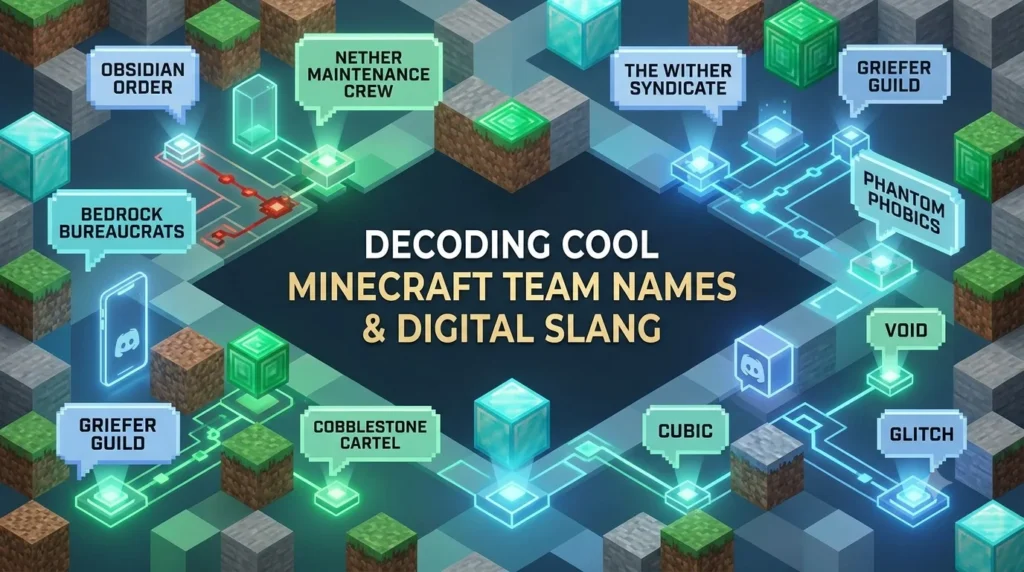
The digital hunt for cool minecraft team names represents far more than a simple search engine query; it is a modern exercise in digital tribalism. In a sandbox world devoid of inherent narrative, players rely on collaborative branding to establish identity, status, and collective purpose. As virtual environments increasingly substitute for physical hangouts, a team’s title functions as a digital coat of arms.
This phenomenon bridges a vital communication gap by signaling a group’s specific gaming ethos—whether they lean toward cutthroat PvP dominance or cozy, cooperative building. The psychology behind these names is rooted in the human need for belonging and shared mythology. By choosing an evocative title, players instantly communicate their collective skill level, sense of humor, and internal hierarchy before placing a single block.
Behind the Screen: Natural Everyday Examples
To understand how these naming conventions shape social dynamics, we have to look at the casual digital spaces where these teams are forged.
Scenario A: The Discord Recruitment Drive
Discord Server — #Faction-Recruitment
Hyperion_9X: Hey guys, we are rebranding the server squad before the Saturday reset. “The Obsidian Order” is way too edgy for 2026.
Voxel_King: True. What about something low-key but intimidating? “Nether Maintenance Crew.”
Hyperion_9X: Lol love it. Sounds casual but implies we absolutely clear the floor.
The Subtext: Moving away from traditional fantasy tropes (“Obsidian Order”) toward ironic, professional-sounding titles (“Nether Maintenance Crew”) demonstrates a shift toward self-deprecating humor. It subverts expectations by framing intense gaming as a mundane day job.
Scenario B: The Twitch Chat Debate
Twitch Live Stream — SMP Bedwars
Streamer_Jay: Chat, help us out. Me, Toby, and Alex need a name for the tournament.
Viewer_01: The Diamond Dogs?
Streamer_Jay: Nah, too basic.
Viewer_02: Bedrock Bureaucrats.
Streamer_Jay: Oh, “Bedrock Bureaucrats” is elite. It sounds unmovable and slightly bureaucratic. We’re locking it in.
The Subtext: Players frequently seek titles that contrast the chaotic, fast-paced nature of gaming with rigid, institutional imagery. It creates a memorable brand that resonates with a highly online audience.
The Subtle Art of Context: Where It Works (And Where It Fails)
Social Spheres and Close Ties
Within a tight-knit circle of gaming friends, a team name acts as an inside joke that solidifies social bonds. It thrives on shared history, in-game blunders, or mutual triumphs. A name like “The Phantom Phobics” or “Cobblestone Cartel” serves as an enduring reminder of late-night adventures and collective experiences, operating as true social glue.
Professional Guardrails
Using gaming-centric nomenclature in a professional workspace is an immediate tonal misalignment. While tech companies occasionally use gamified concepts for team-building exercises, pitching “The Wither Syndicate” or “Bedwars Bandits” during a corporate marketing sync will alienate colleagues and signal a lack of executive presence. In the workplace, keep the terminology anchored in project goals rather than digital server rooms.
Common Friction Points and Misinterpretations
Misunderstandings frequently occur when external observers or older generations interpret these titles too literally. Parents or educators might look at a name like “The Griefers Guild” and assume a group is genuinely malicious, failing to recognize the tongue-in-cheek irony standard in modern gaming culture.
Generational divides also dictate the aesthetic of these choices. Older players (Millennials) often lean toward epic, cinematic references or high-fantasy titles. Conversely, younger demographics (Gen Z and Gen Alpha) favor deeply surreal, minimalist, or lowercase anti-humor designations.
| Terminology | Visual/Conceptual Vibe | Optimal Context | Core Objective |
| Cool Minecraft Team Names | Creative, lore-driven, ironic | Faction servers, SMPs, co-op building | Establishing identity and collective branding |
| Esports Clan Tags | High-energy, aggressive, professional | Competitive PvP tournaments, ranked play | Intimidating opponents and building a brand |
| Guild Designations | Traditional, structured, institutional | MMORPGs, massive public servers | Organizing large-scale player hierarchies |
A Field Guide to Responding
When your gaming group is brainstorming or a new name is proposed, your reaction shapes the identity of the squad.
- The Witty Approach: Build on the irony of the suggestion by proposing a matching in-game skin theme or role structure (e.g., if the team is “Bedrock Bureaucrats,” suggest everyone wears suits).
- The Casual Approach: Validate the vibe quickly to maintain momentum: “That name hits perfectly, let’s update the Discord channel.”
- The Boundary-Setting Approach: If a name leans too far into offensive territory disguised as “edginess,” pivot smoothly: “Let’s keep it clever rather than trying too hard to shock people. How about we go with something more unique?”
- The Professional Approach: If gamifying a casual project at work, steer the ship toward neutrality: “Let’s stick with ‘Sprint Team Alpha’ for the client-facing documents to keep things clear.”
The Global Lifecycle of Digital Slang
The trends governing virtual team names move rapidly across international boundaries. An inside joke popularized on a Korean Minecraft server can be adapted, translated, and deployed on a European faction server within a matter of days.
Because this language relies on the shifting meta of the game itself, these names have distinct expiration dates. A title centered around a specific game mechanic or patch update will feel outdated once the developer introduces new blocks or dimensions. This creates a continuous cycle of linguistic evolution where communities must constantly reinvent their digital brands to remain relevant.
Frequently Asked Questions
What makes a Minecraft team name sound cool?
A great name balances creativity with distinct in-game references. The coolest names avoid overused cliches like “Shadow” or “Slayers” and instead opt for clever wordplay, irony, or deep in-game lore, such as “The Redstone Engineers.”
How do you create an original team name for a Minecraft server?
Combine an unappreciated in-game element (like a specific block, mob, or mechanic) with an unexpected, structured noun. For example, pairing “Mycelium” with “Ministry” gives you the highly original “The Mycelium Ministry.”
What is the difference between a faction name and an SMP group name?
Faction names generally lean toward an aggressive, defensive, or powerful aesthetic to intimidate rivals in PvP. Survival Multiplayer (SMP) group names tend to focus on community, humor, building styles, or shared inside jokes.
Can you use special characters in Minecraft team names?
While some community servers allow special characters, it is best to stick to clean alphanumeric text. This ensures the name remains highly readable in chat logs, scoreboard plugins, and tab menus.
What are some good minimalist team names for gaming?
Minimalist naming conventions emphasize simplicity and lowercase aesthetics. Popular examples include titles like “void,” “cubic,” “glitch,” or single evocative nouns like “Outliers.”
Embracing the Evolution of Language
The ways we label our virtual communities prove that language remains an adaptive, living ecosystem. A simple team name acts as a microscopic cultural artifact, capturing the humor, camaraderie, and shared digital reality of a group of players at a specific moment in time. By peering closely at these digital tags, we don’t just see video game text—we witness a timeless human drive to build community, establish identity, and find connection within a world made of blocks.