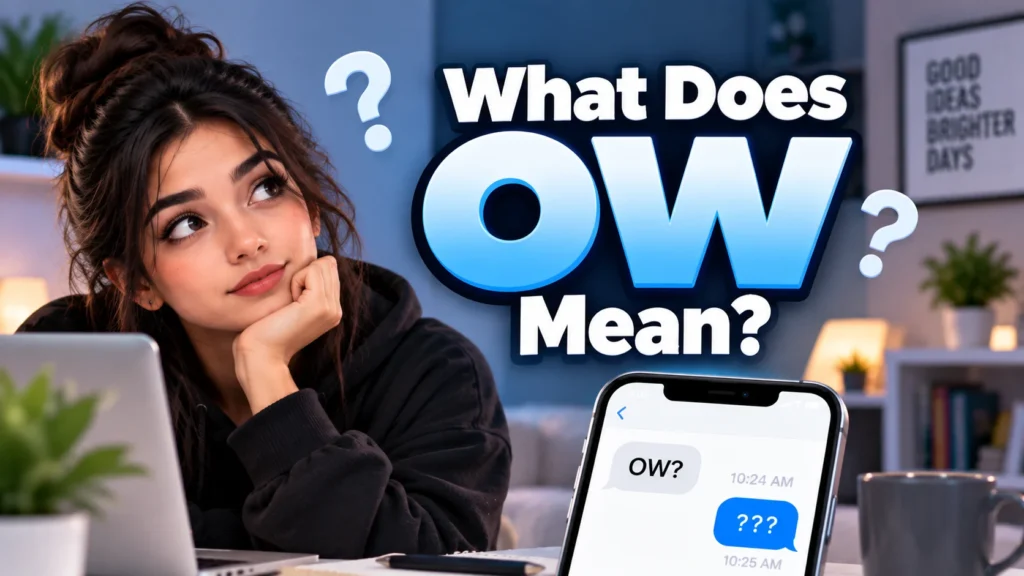
Seeing “ow” in a message may look straightforward, but the meaning can change surprisingly quickly depending on capitalization and context.
In ordinary English, ow is an exclamation used when someone feels sudden pain. Dictionaries such as Cambridge, Merriam-Webster, Oxford, and Collins all define it this way.
In texting, however, uppercase OW can sometimes stand for Other Woman, particularly in relationship or infidelity discussions. Some slang references also record Oh Well as a secondary interpretation.
Gamers may read the same letters as Overwatch, while other communities use them for specialized terms such as Open Water or one-way.
The easiest way to understand those two letters is therefore to look beyond the letters themselves. Tone, topic, capitalization, and the surrounding sentence usually reveal the intended message.
OW – Quick Meaning
The most common everyday meaning is simple:
“Ow!” = an expression of sudden pain or discomfort.
For example:
“Ow! I hit my knee.”
“Ow, that comment was harsh 😭”
“Ow 😭 why would you say that?”
Dictionary.com describes “ow” as an expression of intense or sudden pain, while Cambridge gives the same basic definition.
When written as an abbreviation, though, OW can mean several things:
- Ow/Ouch — pain or emotional discomfort
- Other Woman — relationship discussions
- Oh Well — resignation or acceptance
- Overwatch — gaming
- One-Way — transportation or directional shorthand
- Open Water — diving and sports contexts
Merriam-Webster even lists OW as an abbreviation for “one-way.”
The conversation tells you which definition fits.
Origin & Background
The Pain Expression Came First
The ordinary English interjection “ow” has been used for a long time.
Merriam-Webster dates its first known English use to 1834, while Oxford notes that the natural exclamation was first recorded in English during the nineteenth century.
Unlike many internet abbreviations, it was not created by texting.
It represents the natural sound people make when something hurts.
Someone might say:
“Ow!”
after touching a hot surface, bumping into furniture, or getting pinched.
Texting simply transferred that spoken reaction onto screens.
From Physical Pain to Emotional Pain
Digital conversation expanded the word.
Now someone might write:
“ow 💔”
even though nothing physically hurt them.
The pain is emotional.
A harsh joke, rejection, embarrassing comment, or blunt truth can all receive an “ow” response.
That gives the tiny expression more emotional range than its dictionary definition may initially suggest.
How OW Became an Abbreviation
Capitalized OW developed separate meanings inside different communities.
Relationship forums and texting references use it for Other Woman, usually referring to a woman involved with someone who is already in a relationship. CyberDefinitions and All Acronyms both document this usage.
Gamers adopted OW as shorthand for Overwatch, Blizzard Entertainment’s team-based game franchise. General reference sources also list Overwatch among established meanings of OW.
The same letters therefore evolved independently in different communities.
Real-Life Conversations
Person A: I just walked straight into the table 😭
and,
Person B: OW 😂 are you okay?
moreover,
Person A: My leg is fine. My dignity isn’t.
Here, the word is simply a reaction to physical pain.
Instagram DMs
Person A: Your new haircut makes you look ten years older.
Person B: ow 😭
and,
Person A: WAIT I meant mature, not old.
Person B: Too late 😂
Nothing physical happened. “Ow” signals that the comment emotionally stung.
TikTok Comments
Person A: What does OW mean in all these relationship posts?
Person B: Usually “Other Woman.”
and,
Person A: Like someone involved with a married guy?
Person B: That’s the type of context where people use it.
Here, the capitalization and relationship topic point toward the abbreviation rather than the pain reaction.
Gaming Chat
Person A: You getting on OW tonight?
Person B: Yeah, around 9.
and,
Person A: Competitive?
Person B: Probably.
In a gaming conversation, OW clearly means Overwatch.
Emotional & Psychological Meaning
The ordinary “ow” is interesting because it can function like a digital facial expression.
When people talk face to face, they can hear tone and see body language.
Text removes those clues.
Writing:
“ow 😭”
lets the reader know:
“That hurt.”
The hurt might be physical, emotional, humorous, or exaggerated.
Playful Hurt
Friends often use it after teasing.
Person A: You can’t cook.
Person B: ow 💀
The second person may not actually feel offended. They are theatrically pretending the joke caused damage.
Genuine Emotional Hurt
The same word can become much more serious.
Person A: I don’t think I ever really loved you.
Person B: Ow.
Without emojis or laughter, the short reply can feel heavy.
Its simplicity emphasizes the emotional impact.
A Personal-Style Scenario
Imagine sending a photo of an outfit you genuinely love.
Your friend replies:
“Not your best look.”
You type:
“ow 😭”
You probably are not deeply devastated.
Still, the message tells your friend their comment landed harder than expected.
That is why such a small word works so well online. It quickly signals emotional impact without requiring a long explanation.
Usage in Different Contexts
Social Media
On TikTok, Instagram, Snapchat, and X, lowercase “ow” usually reacts to:
- painful videos;
- embarrassing moments;
- harsh jokes;
- rejection;
- emotional stories;
- unexpected criticism.
Example:
“That ending hurt.”
“ow 💔”
It functions almost like “ouch.”
Friends & Relationships
Among friends, it can be playful.
“Bro said I have zero fashion sense.”
“OW 😭”
In relationship forums, however, uppercase OW may be shorthand for Other Woman.
For example:
“My husband is still contacting the OW.”
In that sentence, “ouch” makes no sense. Relationship terminology provides the clue.
Gaming
OW often refers to Overwatch.
Examples include:
“OW ranked”
“OW players”
“playing OW tonight”
“OW patch”
Anyone familiar with gaming will usually understand this immediately.
Professional Settings
The pain expression rarely belongs in formal communication unless someone is deliberately being conversational.
Writing:
“Ow, that deadline hurts!”
might work between close coworkers.
It would be unsuitable in a formal client email.
Likewise, unexplained abbreviation use should be avoided when the audience may not know the intended definition.
When NOT to Use It
Avoid “ow” when the situation requires precise or professional language.
If someone is experiencing actual significant pain, writing only:
“ow”
does not explain what happened.
Use clear language such as:
“My wrist hurts after I fell.”
The abbreviation OW = Other Woman should also be used carefully.
Calling a real person “the OW” can reduce a complicated relationship situation to a label and may sound judgmental.
In serious discussions, more precise wording can be better.
You should also avoid assuming that every capitalized instance has a relationship meaning.
“Playing OW tonight” obviously refers to a game.
“OW traffic only” might refer to one-way traffic.
Context matters more than capitalization alone.
Common Misunderstandings
OW Is Not Always an Acronym
This is probably the biggest mistake.
Lowercase “ow” is often simply an English interjection.
It does not stand for anything.
Cambridge defines it directly as a word used to express sudden pain.
OW Does Not Always Mean Other Woman
That interpretation is real, but relatively niche.
CyberDefinitions explicitly describes Other Woman as a texting meaning while warning that OW is uncommon enough for context to matter.
OW Can Mean Oh Well
Some texting references list Oh Well as another interpretation.
Someone might write:
“Didn’t get the tickets. OW.”
Here, “Oh well” can make sense as a resigned reaction.
Still, spelling out “oh well” is much clearer.
OW Is Common Gaming Shorthand
Gamers may use OW without explanation because their community already knows it means Overwatch.
Someone outside that community may not recognize it.
Ow and Ouch Are Very Similar
In everyday English:
“Ow!”
and:
“Ouch!”
serve essentially the same purpose.
Both express pain, although speakers may choose one naturally based on personal habit.
Comparison Table
| Expression | Common Meaning | Typical Context | Tone |
|---|---|---|---|
| ow | Expression of pain | Everyday speech/text | Painful/reactive |
| ouch | Expression of pain | Speech/text | Painful/reactive |
| OW | Other Woman | Relationship forums | Serious/sensitive |
| OW | Overwatch | Gaming | Neutral |
| OW | Oh Well | Some texting | Resigned |
| OW | One-Way | Transport/directions | Neutral |
| OOF | Reaction to pain/awkwardness | Internet slang | Humorous |
| RIP | Reaction to failure/loss | Internet slang | Humorous/serious |
| Yikes | Discomfort or surprise | Text/social media | Reactive |
| Damn | Surprise/frustration | Casual speech | Stronger |
Key Insight
The clearest distinction is between “ow” as a natural reaction and “OW” as context-specific shorthand. If someone reacts immediately to something painful or harsh, think “ouch.” If the message discusses relationships, gaming, or another specialized topic, look for an abbreviation instead.
Variations / Types of OW
1. Ow
Meaning: Sudden pain.
Example:
“Ow! That hurt.”
This is the standard dictionary use.
2. ow 😭
Meaning: Playful or emotional pain.
Common after teasing, embarrassing moments, or upsetting comments.
3. ow 💔
Meaning: Emotional hurt.
The broken-heart emoji makes the intended feeling obvious.
4. OWWW
Meaning: Strong or exaggerated pain.
Repeating the final letter adds intensity.
Example:
“OWWW I hit my elbow 😭”
5. OW = Other Woman
Meaning: A woman involved with someone who already has a partner.
This appears particularly in relationship and infidelity discussions.
6. OW = Oh Well
Meaning: Acceptance of an unfortunate situation.
Example:
“Guess we missed it. OW.”
This form is less universally understood.
7. OW = Overwatch
Meaning: Blizzard’s gaming franchise.
Example:
“Anyone playing OW tonight?”
8. OW = One-Way
Meaning: Moving or operating in only one direction.
Merriam-Webster lists OW as an abbreviation for one-way.
9. OW = Open Water
Meaning: Open-water environments, often in diving or sports-related terminology.
The surrounding activity usually makes this clear.
10. Ow as Emotional Emphasis
Sometimes writers use “ow” almost theatrically.
Example:
“That truth hurts. Ow.”
It communicates emotional impact even when no physical injury exists.
How to Respond When Someone Uses OW
Casual Replies
If someone says:
“ow 😭”
you might reply:
“Sorry 😂”
“You okay?”
“My bad!”
“I didn’t mean it like that.”
Funny Replies
“Emotional damage 😭”
“I’ll pay your hospital bill 😂”
“That one landed.”
“Sending virtual ice 🧊”
Mature Replies
If the person seems genuinely hurt:
“I’m sorry. That came out harsher than I intended.”
“I didn’t mean to hurt your feelings.”
“Are you okay?”
Respectful Replies
When relationship shorthand is being used:
“Do you mean ‘Other Woman’ by OW?”
“Thanks, that makes the context clearer.”
When gaming is involved:
“Overwatch?”
“Which mode are you playing?”
Clarifying is perfectly reasonable because the abbreviation has several legitimate interpretations.
Regional & Cultural Usage
Western Culture
The pain expression “ow” is standard English and widely understood across English-speaking countries.
Its pronunciation is generally represented as /aʊ/, similar to the vowel sound in “how.” Cambridge and Oxford both document this pronunciation.
Asian Culture
English learners throughout Asia often encounter “ow” through films, cartoons, games, and social media.
It is easy to understand because it mimics a natural pain reaction.
Uppercase abbreviation meanings are more likely to depend on online communities than geography.
Middle Eastern Culture
The same applies across Middle Eastern English-language communication.
Someone may understand ordinary “ow” immediately while having no familiarity with “OW” as relationship slang.
That makes context particularly important in multilingual conversations.
Global Internet Usage
Online communities frequently create shorthand that makes sense internally but appears mysterious to outsiders.
Gamers know Overwatch.
Relationship forums may recognize Other Woman.
Ordinary users see “ow” and think pain.
These meanings coexist because the internet brings unrelated communities into the same search results.
Gen Z vs. Millennials
Both generations understand the ordinary pain reaction.
Younger users may stylize it more dramatically:
“owww 😭💀”
Older internet users may be more familiar with traditional forum abbreviations such as OW for Other Woman.
Gamers of different ages may recognize the Overwatch shorthand.
The differences are therefore more community-based than strictly generational.
Is OW Safe for Kids?
Yes, the ordinary expression “ow” is completely safe for kids.
It simply communicates pain.
Children often learn it naturally alongside words such as:
“ouch”
“oops”
and:
“uh-oh.”
The gaming abbreviation Overwatch is also not inherently inappropriate as a term, though parents may make separate decisions about individual games and online interactions.
The relationship abbreviation Other Woman involves adult relationship themes, but the letters themselves are not profanity or explicit language.
A child-friendly explanation is:
“Ow is something people say when something hurts. Capital OW can sometimes be an abbreviation for other things.”
FAQs
What does OW mean in text?
Most commonly, lowercase “ow” means “ouch” and expresses pain, discomfort, or emotional hurt. In some texting contexts, uppercase OW can stand for Other Woman or Oh Well.
What does OW mean from a girl?
If she sends “ow” after a joke, comment, or upsetting message, she probably means that it hurt physically or emotionally. The letters alone do not indicate romantic interest.
What does OW mean from a guy?
It normally carries the same meaning regardless of gender. He may be reacting to pain, teasing, embarrassment, or an emotionally sharp comment.
What does OW mean in relationships?
In relationship forums and discussions about infidelity, OW can mean “Other Woman.” The term typically refers to a woman involved with someone who already has a partner.
What does OW mean in gaming?
OW commonly stands for Overwatch in gaming conversations. A phrase such as “playing OW tonight” usually refers to the game rather than the pain expression.
Does OW mean Oh Well?
It can. Some texting references list Oh Well as a secondary abbreviation, typically expressing resignation or acceptance. However, this use is less immediately recognizable than simply writing “oh well.”
Is “ow” the same as “ouch”?
In everyday English, they are very similar. Both are interjections used when something hurts, although “ow” may feel more immediate and instinctive.
Conclusion
Those two letters are far more flexible than they first appear.
In ordinary English, ow is simply an expression of pain. It can react to a stubbed toe, a painful fall, a cruel joke, or an emotionally uncomfortable truth.
Online conversation has expanded that simple reaction.
“ow 😭”
can mean:
“That joke hurt.”
“ow 💔”
can communicate genuine emotional pain.
Capitalized OW can move into completely different territory.
In relationship discussions, it may mean Other Woman.
Among gamers, it often means Overwatch.
Some texting communities use it for Oh Well, while technical contexts may use the same letters for terms such as one-way or open water.
The simplest way to decode it is to examine what happened immediately before the message.
Someone got hurt or roasted?
Think “ouch.”
A discussion about an affair?
Think Other Woman.
A gaming conversation?
Probably Overwatch.
A disappointed person accepting bad luck?
Oh Well may fit.
That context-first approach is much more reliable than assigning one definition to every appearance of the letters.
For high CTR (click-through rate), titles and descriptions should create curiosity, a clear benefit, and a reason to click without giving everything away.